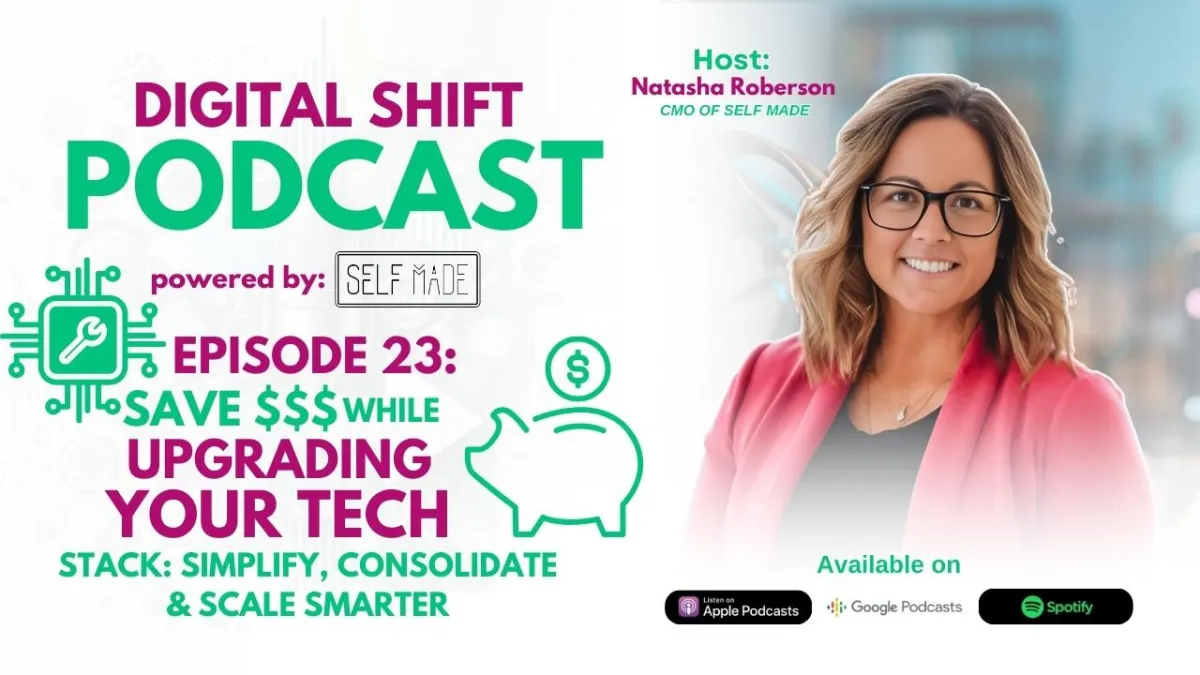
Episode 23: Save $$$ While Upgrading Your Tech Stack: Simplify, Consolidate & Scale Smarter
Every entrepreneur hits a point where running their business starts to feel less like growth… and more like juggling mismatched tools that never quite work together. One login for email. Another for scheduling. Another for funnels. Another for courses. Another for texting. And the list goes on.
It feels normal—because so many business owners do it.
But “normal” is expensive. Draining. And wildly inefficient.
In Episode 23 of The Digital Shift™, Natasha Roberson shines a bright light on what she calls the silent money leak in modern entrepreneurship: your tech stack.
Most business owners don’t realize just how much their scattered tools are costing them—not only in dollars, but in time, clarity, and mental bandwidth. And once Natasha lays it out, it becomes impossible to ignore.
Let’s break it all down.
The Hidden Cost of a Messy Tech Stack
It’s no surprise that today’s digital entrepreneur leans heavily on tech. The real shock comes when you sit down and actually add up the price tags.
Most business owners are using:
An email marketing platform
A CRM
A funnel builder
A website tool
A texting platform
A scheduler
A course or membership platform
A social media scheduler
Individually, each tool seems harmless.
Together? They quickly climb to $500–$700 per month—sometimes more.
And the cost isn’t just financial.
When your tools don't talk to each other, YOU become the glue.
You’re manually connecting dots.
Fixing broken integrations.
Updating links.
Managing five different support teams.
Logging into a dozen different dashboards daily.
It’s no wonder entrepreneurs feel overwhelmed—your systems are overwhelming you.
It’s Not a Time Problem—It’s a System Problem
Natasha explains that the reason most entrepreneurs feel constantly behind has nothing to do with discipline or time management.
It’s the fragmentation.
Every tool requires:
Its own login
Its own learning curve
Its own setup
Its own updates
Its own support
Multiply that times 8–10 tools… and your workday becomes a maze.
You’re not disorganized—your systems are.
And that’s the good news, because systems can be simplified.
How to Audit Your Tech Stack (and What to Cut First)
Natasha walks through a simple but eye-opening exercise:
Step 1: List your tools
Every single one—big and small.
Step 2: Write down the cost of each tool
Monthly or annual—calculate both.
Step 3: Label each tool by category:
Email
Funnels
CRM
Scheduling
Courses/memberships
SMS
Social tools
Step 4: Highlight overlaps
Most people discover they’re paying for 2–3 tools that do the same thing.
Step 5: Choose one all-in-one platform that handles 80–90% of your work
That final step is where the real magic happens.
Real Clients Who Saved Hundreds by Consolidating
Natasha shares a story that feels all too familiar:
A client came to her using seven different tools.
Her monthly bill? Over $700.
By moving everything into one all-in-one system, she:
Cancelled 6 subscriptions
Saved over $600 per month
Reduced her weekly tech tasks by 12 hours
Stopped fighting with integrations
Got all her analytics, leads, and workflows in one dashboard
And—no surprise—her business grew faster once her system was clean and cohesive.
What to Look for in an All-in-One Platform
Natasha breaks down the non-negotiables for consolidation:
1. Built-in automation
Email, SMS, CRM workflows—all connected.
2. Funnel builder + website builder
No extra subscriptions or learning curves.
3. Course + membership hosting
Your digital products should live under the same roof.
4. Social scheduling
One more tool eliminated.
5. Centralized dashboard
Leads, sales, analytics, tasks—all visible at a glance.
6. Easy for non-techies
If it isn’t simple, you won’t stick with it.
This is exactly why Natasha uses and recommends Self Made Hub.
FAQs: The Most Common Concerns About Switching Platforms
1. “I already paid for a year of my tools. Should I wait?”
No. You’ll start saving money immediately by consolidating—why delay the savings?
2. “All-in-one platforms seem complicated.”
Not the Self Made Hub. It’s designed specifically for business owners who aren’t tech experts.
3. “Will I lose my data switching?”
No—migration support makes the transition smooth and secure.
4. “Can one platform really do everything well?”
Absolutely. When the system is built for entrepreneurs, it covers email, funnels, CRM, SMS, courses, scheduling, and more—seamlessly.
5. “Why not just add another tool instead of switching?”
Because more tools bring more chaos.
The goal is simplicity, not clutter.
Action Step of the Episode: Audit Your Tools Today
Take 10–15 minutes and do a full tech audit.
Write down:
What you use
What it costs
What features you actually use
Then identify two tools you can eliminate or combine.
Just two.
That alone can save you hundreds each month.
Ready to Simplify Your Tech and Scale Smarter?
If tech overwhelm is slowing your growth, the solution isn’t more tools—it’s a smarter system.
With Self Made Hub, you can:
✔ Cancel 6+ subscriptions
✔ Build funnels, emails, and automations in one place
✔ Host courses and memberships
✔ Track leads and analytics on one dashboard
✔ Save $300–$500 per month instantly
🔗 Join the Self Made Hub: www.self-made.biz/membership-options
You deserve a business that feels streamlined—not scattered.
Final Takeaways
You don’t need more tools—you need better systems
Most entrepreneurs overspend on tech they don’t even use
Consolidation brings clarity, time freedom, and peace
All-in-one platforms aren’t the future—they’re the present
A smooth-running business doesn’t require 12 different subscriptions.
Just one smart system that works with you—not against you.