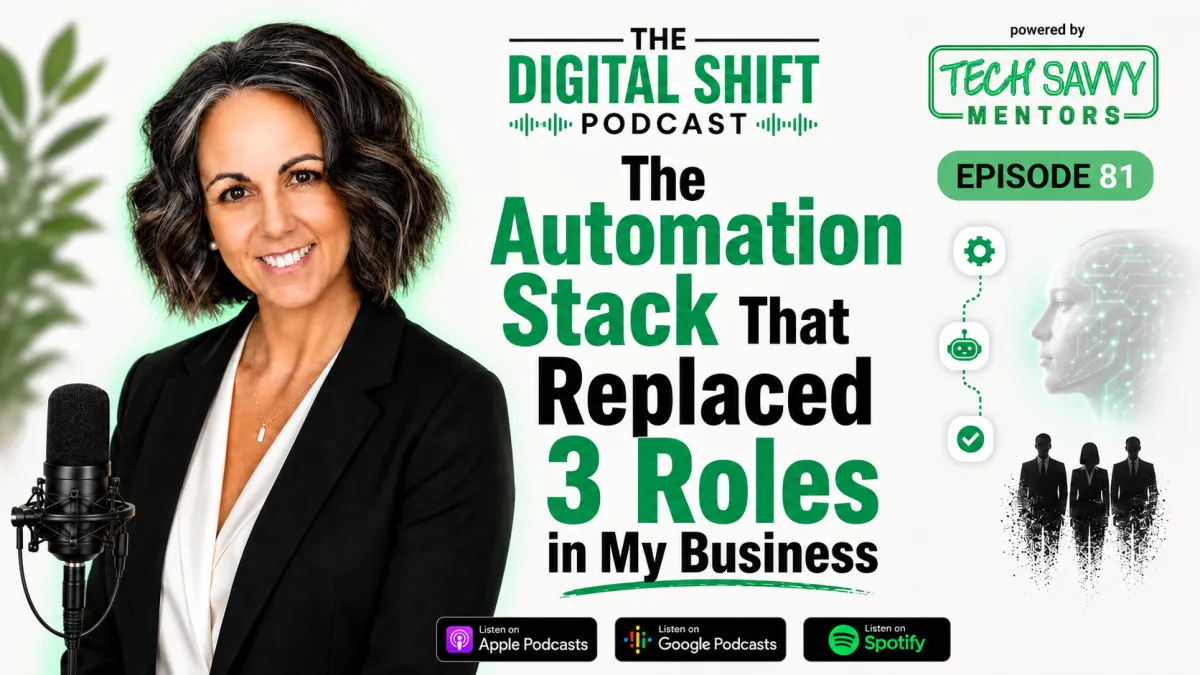
Podcast Episode 81 — The Automation Stack That Replaced 3 Roles in My Business
There was a season where I was the follow-up person, the onboarding coordinator, and the client success manager all at once, and I had a team.
That is not a team problem. That is a systems problem. And it took me longer than I want to admit to see the difference.
Every time something fell through the cracks, my instinct was to put a person on it. Hire someone to follow up faster. Hire someone to make clients feel taken care of. Hire someone to catch the ones who were going quiet. And for a while, that looked like it was working, because we were catching more things. But the workload kept growing, the team kept getting stretched, and I was still the one holding the whole thing together in my head.
The fix was not another hire. The fix was building the system that should have existed before we hired anyone.
In Episode 81 of The Digital Shift™, I walk through the exact automation stack I built inside GoHighLevel to replace three critical business roles, not to cut people, but to free my team to do the work that a human is actually needed for.
The question I ask before every hire now
Before I build a job description or open a role, I ask one question: is this a people problem or a systems problem?
Because if it is a systems problem, a new hire just inherits the broken system. You are not solving anything. You are giving the chaos a name and a salary.
Most of the time, when I dig into what feels like a capacity problem, what I find is a gap in automation. A workflow that was never built. A follow-up sequence that was supposed to exist but never got set up. A client check-in process that lives in someone's head instead of inside GHL.
When those gaps exist, hiring is expensive and temporary. Building the system is permanent.
The 3 roles the automation stack replaced
Role 1: The Follow-Up Person
This was the role that felt most urgent for the longest time, because leads were going cold and we knew it. Someone would opt in, and if the response was not fast enough, they were gone. We were losing people at 2am, on weekends, during launches, anywhere a human could not physically be awake and watching a pipeline.
The stack I built starts with AI-powered speed-to-lead that fires within seconds of every new opt-in, regardless of the time. From there, behavior-triggered nurture adjusts based on what each lead does, what they click, what they ignore, what they come back to. An AI conversation layer qualifies leads and routes the warm ones to the team so the only conversations humans are having are the ones that matter.
No lead goes cold. No one on the team is manually chasing opt-ins at midnight.
Role 2: The Onboarding Coordinator
The moment a payment clears, a client's experience of your business starts. Most businesses treat onboarding like an afterthought, a welcome email, a login, and then silence. That silence is where doubt creeps in and where refund requests start forming.
The onboarding workflow I built fires the moment payment is confirmed. It delivers a warm, personal welcome, gives the client a quick win within the first 24 hours, and walks them through a structured sequence that is personalized to their business type and goals. By the time a client has their first real conversation with a team member, they already feel taken care of, they already know what to expect, and they are already moving.
That experience used to depend entirely on one person executing it consistently. Now the system does it, every time, for every client, without fail.
Role 3: The Client Success Manager
This one is the role most businesses do not even realize they are missing until a client cancels or goes quiet and it is too late to do anything about it.
The client success stack inside GHL monitors behavior. It catches disengagement before it becomes a cancellation. It celebrates milestones so clients feel seen at the moments that matter most to them. It identifies clients who are ready to move up to the next level, and it triggers referral asks at the exact moment of peak satisfaction, not randomly, not on a schedule someone set six months ago, but at the moment the data shows the client is most likely to say yes.
This is not something a human can do consistently at scale. The human element comes in after the system flags what needs attention. The team shows up for the conversation. The system handles the monitoring.
What your team should actually be doing
When the system is handling follow-up, onboarding, and client monitoring, your team gets to do the thing that a system cannot: show up as a human for another human.
Strategic conversations. Real mentorship. Problem-solving that requires context and judgment. Relationship-building that turns a satisfied client into an advocate. That is where your team's time should go, and it is where they will do their best work.
The automation does not replace the team. It clears the noise so the team can do what they were hired to do.
What the system cannot replace
There are things inside GHL that no automation can do, and I want to be clear about what those are.
Culture fit. The read you get when you are on a call with someone and you know, without being able to explain exactly why, that they are the right person for this work. The mentorship relationship that turns a good client into a loyal one. The leadership that holds a team together through a hard season. The vision that gives everyone a direction to move toward.
The system handles the operational layer so the humans can focus on the human layer. That is the distinction, and it matters.
Where to start if you want this stack
Most of the people I talk to are not missing the desire to build this. They are missing the clarity on what to build first.
If you want to know exactly where your systems are leaking leads, dropping clients, or creating bottlenecks, start with the free GHL Business Audit. It looks at your current setup, identifies the gaps, and gives you a simple plan for what to build first. No overwhelm. No guesswork. Just a clear picture of where to focus next.
Take the Free GHL Business Audit: www.self-made.biz/ghl-audit
Natasha Roberson is the Co-Owner and CXSO of Self-Made Biz and co-host of The Digital Shift™. She specializes in automation architecture, marketing systems, and building the operational infrastructure that lets businesses scale without adding chaos. You can listen to The Digital Shift™ on Spotify, Apple Podcasts, and Amazon Music.