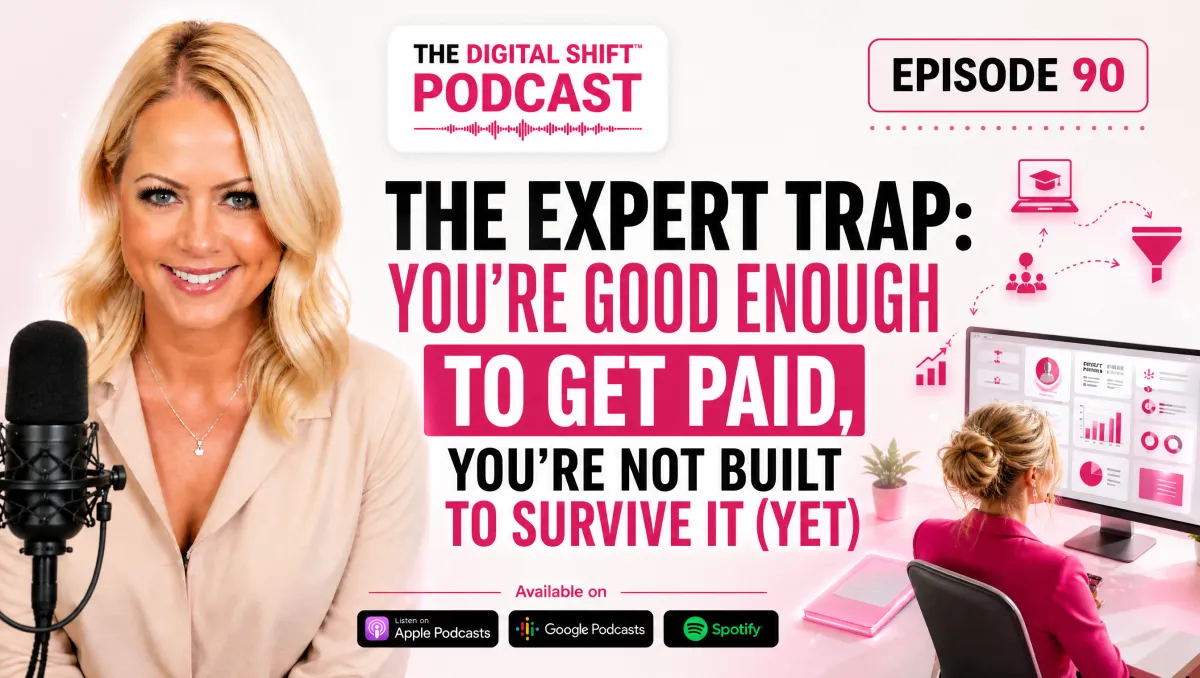
Podcast Episode 90 — The Expert Trap: You're Good Enough to Get Paid, You're Not Built to Survive It (Yet)
I talk to women constantly who are incredible at their craft. So good at what they do that someone finally asked, can you teach me how you do that. That question feels like proof. Like validation. Like the business plan wrote itself.
It's also, almost always, exactly where the trouble starts.
Being good at your craft and having a sellable offer are two completely different businesses, and Episode 90 walks through the three checkpoints I run every student through before they price anything, package anything, or promise anything to a client.
Is this a business, or a hobby with a price tag?
Here's the blunt version. If nobody has asked you for this offer unprompted, if you can't explain the result in one sentence, if you built the curriculum before you had a single buyer, if you picked a price because it felt right instead of doing the math, or if you're scared to charge for it, you're not running a business yet. You're running a hobby with a price tag on it, and I say that with love, because I've watched it happen up close more times than I can count.
An idea in your head is not an offer in the market. It's a rumor until someone pays you for it.
That's not a failure. It's a starting point. It's exactly why the next two checkpoints matter more than any of it.
The three checkpoints
Checkpoint one: is it real
Someone has to want this before you build it, not after. If the only person excited about the offer is you, that's a diary entry, not a business plan. Validate first. Build second.
Checkpoint two: does the math work
This is the one that costs people the most, and it's the one nobody wants to do. A student I'll call Jenny came to Tech Savvy School with her course and group coaching program already built. She had a price picked. Her curriculum was mapped. She was ready to launch.
What she hadn't done was run the real long-term math on what that price meant once you packaged the whole thing together, the delivery time, the support load, what it would actually take to run month after month instead of just sell once. When we sat down and ran the numbers on how she had it structured, the truth was clear. She would never have made enough to survive on it, let alone build a business on it.
Not because her offer was bad. Not because her craft wasn't real. Because nobody had made her do the math before she launched.
We rebuilt the plan together, repriced it, restructured the packaging, and what she walked away with finally felt sustainable. She still says that was her biggest win from the program. Not a funnel. Not a template. The math.
Pricing isn't a vibe. It's arithmetic with a little courage attached. Most of the time, undercharging isn't a pricing problem. It's a confidence problem wearing a spreadsheet costume.
Checkpoint three: can you actually deliver it
A great offer with no delivery system is just a convincing way to disappoint people at scale. I had a student, I'll call her Theresa, who'd been selling her program for years with real demand and real word of mouth. A whole suite of offers, a flagship course, a couple of standalone programs, a membership. None of it had structure or automation underneath it.
It caught up with her. Client emails and calls didn't go out when they were supposed to, and it cost her real trust with real clients. Not because she didn't care. Because there was no system holding the promise she'd made.
What changes once the system exists
Here's the shape of what we're building for Theresa instead, because it's the blueprint for a lot of you reading this. A free weekly live event, a simple 60-minute educational session, builds a warm, qualified audience every week instead of relying only on word of mouth. Inside that event, a short offer for a low-ticket entry product covers ad spend and brings people into her world at a low-risk price point. An upsell right after that means the first purchase isn't the ceiling, it's the doorway. From there, an automated nurture sequence gives people a clear path to her bigger programs, with a booking process that pre-qualifies people on price before they ever get on a call with her.
Her content creation stays hers. The technical infrastructure, the automation, the funnel build, that gets handed to the right people so she's not holding the whole machine together by hand anymore.
Word of mouth got her this far. It won't get her to the next level. Structure will.
What this can't replace
None of this works without the craft. Systems don't manufacture demand out of nothing, and no funnel fixes an offer nobody wants. The math and the machine only matter once checkpoint one is true. Build the structure on top of something real, not instead of it.
Where to start
If you read that and thought, I think I'm missing at least one of these checkpoints, that's exactly why we built the Challenge. Five days to get real clarity on your offer, your numbers, and your systems, so you're not building blind the way Jenny almost did, or running for years without structure the way Theresa was. Platinum seats include a hot seat and a full audit on your actual numbers and your actual funnel, the same kind of audit that caught Jenny's pricing before it cost her the business.
Craft was never the hard part for you. You already have that. The math and the machine underneath it are what decide whether this becomes a business or stays a hobby.
Save your seat in the Challenge: https://www.self-made.biz/challenge
Jessica Green is CEO and founder of Self-Made Biz, business strategist, and host of The Digital Shift™ podcast. New episodes drop weekly on Spotify, Apple Podcasts, and Amazon Music.