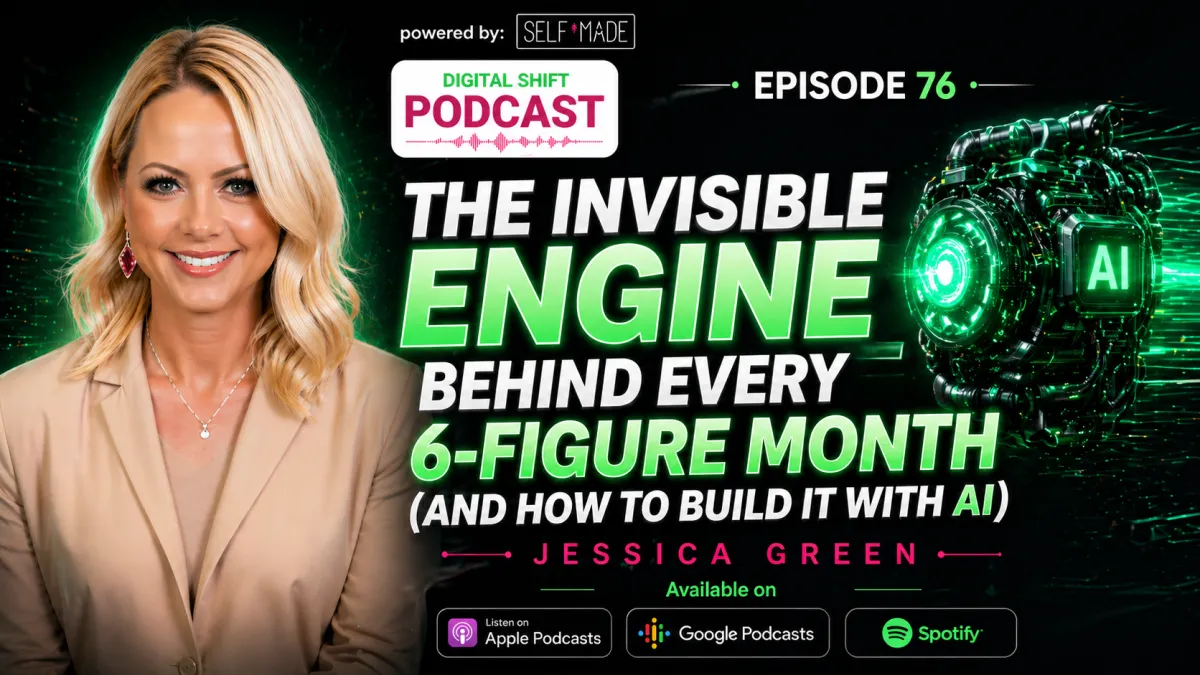
Podcast Episode 76 - The Invisible Engine Behind Every 6-Figure Month (And How to Build It With AI)
If you’ve ever looked at a successful business and thought:
“How are they growing so consistently without burning out?”
The answer is usually not better content.
Not more hustle.
And not some secret algorithm trick.
The answer is infrastructure.
Behind every scalable business is an invisible engine — a system of operations, automation, data, delivery, and decision-making that allows growth to happen consistently without the business collapsing under its own weight.
In Episode 76 of The Digital Shift™, Jessica Green breaks down exactly what this invisible engine looks like and how AI is changing the way modern businesses scale in 2026.
If your business feels overly dependent on you, constantly reactive, or difficult to scale cleanly, this episode explains why.
Why Most Businesses Struggle to Scale
One of the biggest misconceptions in entrepreneurship is the belief that scaling requires more effort.
More content.
More launches.
More offers.
More hours.
But most businesses don’t stall because the owner isn’t working hard enough.
They stall because the business was never built to hold larger growth.
Many entrepreneurs unintentionally become the bottleneck in their own company because every decision, process, approval, follow-up, and operational task depends on them personally.
That works at smaller revenue levels.
It breaks at scale.
This is why six-figure months are not simply revenue milestones.
They are operational milestones.
A business must have systems capable of supporting that level of demand.
The 4 Layers of the Invisible AI Engine
Inside the episode, Jessica explains the four foundational layers required to build a scalable business infrastructure using AI and automation.
These layers are what allow businesses to grow without chaos.
1. Operations Layer
The operations layer removes manual bottlenecks from the business.
This includes things like:
Automated workflows
Team routing
CRM processes
Task delegation
Backend organization
Process automation
Without operational infrastructure, growth creates overwhelm instead of leverage.
Businesses become reactive instead of proactive.
The goal of this layer is simple:
Reduce friction and eliminate unnecessary manual work.
2. Data Layer
Most entrepreneurs make decisions using incomplete or inaccurate data.
That creates major problems when scaling.
The data layer ensures the business has:
Accurate reporting
Clean CRM tracking
Revenue visibility
Customer behavior insights
Performance analytics
Financial clarity
As Jessica explains in the episode, many businesses are unknowingly operating from incorrect information — which leads to poor pricing decisions, ineffective marketing, and unclear growth strategies.
AI allows businesses to process and organize massive amounts of operational data far faster than manual analysis ever could.
And in 2026, data clarity is competitive advantage.
3. Delivery Layer
This is the layer most entrepreneurs fear losing during growth.
The fear of:
“What happens to my standards when I scale?”
The delivery layer protects the customer experience while the business grows.
This includes:
Client onboarding systems
Automated communication
Fulfillment workflows
Customer journey management
Internal quality control
Support systems
When this layer is built correctly, entrepreneurs no longer feel like they have to personally hold every part of the customer experience together.
The business itself becomes capable of maintaining standards consistently.
4. Growth Layer
The growth layer uses AI and business intelligence to guide strategic decision-making.
Instead of guessing what is working, businesses can identify:
Which offers convert best
Where leads are dropping off
Which marketing channels perform strongest
Which systems create the highest ROI
Where operational leaks exist
This allows entrepreneurs to stop spreading energy across dozens of disconnected strategies.
Instead, they can focus on the specific actions producing measurable growth.
Why AI Is Becoming Essential for Modern Businesses
AI is no longer just a content tool.
It is operational infrastructure.
Businesses integrating AI into their backend systems are gaining significant advantages in:
Speed
Efficiency
Decision-making
Reporting
Automation
Customer experience
Scalability
Meanwhile, businesses relying entirely on manual operations are finding it increasingly difficult to keep pace.
As discussed in the episode:
“AI doesn’t replace CEOs. It exposes the ones who aren’t actually operating like one.”
The entrepreneurs who win in 2026 will not necessarily work harder.
They will build smarter systems.
The Real Shift: From Operator to CEO
One of the most powerful concepts in this episode is the identity shift required for scaling.
Many entrepreneurs are still operating as the primary engine of the business.
But scalable companies are not built around constant personal output.
They are built around systems that create consistent results.
The shift is moving from:
Reactive → strategic
Manual → automated
Guessing → data-driven
Hustling → engineered growth
And that shift starts with a decision:
To stop being the bottleneck.
Where to Start If Your Business Feels Heavy
Jessica shares three practical starting points for entrepreneurs ready to simplify and scale smarter.
Audit Before You Add
Before implementing more tools or automation, identify:
What is currently broken
Where time is being lost
Which processes feel chaotic
What is creating the biggest operational friction
You cannot build clean systems on top of messy foundations.
Focus on One Layer at a Time
Trying to rebuild everything simultaneously creates more overwhelm.
Instead, identify the single layer causing the biggest issue right now:
Operations
Data
Delivery
Growth
Then fix that layer properly before moving on.
Stop Trying to Figure It Out Alone
One of the fastest ways to scale is proximity to people who have already built what you’re trying to build.
This is why mentorship, implementation support, and strategic guidance matter so much in today’s business landscape.
Because the goal is not endless trial and error.
The goal is leverage.
Final Thoughts
Six-figure months are not random.
They are not luck.
And they are not created through hustle alone.
They are the result of businesses intentionally built to support growth.
The invisible engine matters.
And in 2026, the businesses that scale fastest will be the ones combining smart systems, AI integration, operational clarity, and strategic infrastructure.
If you’re ready to stop duct-taping your backend together and start building a business designed for scale, this episode is essential listening.