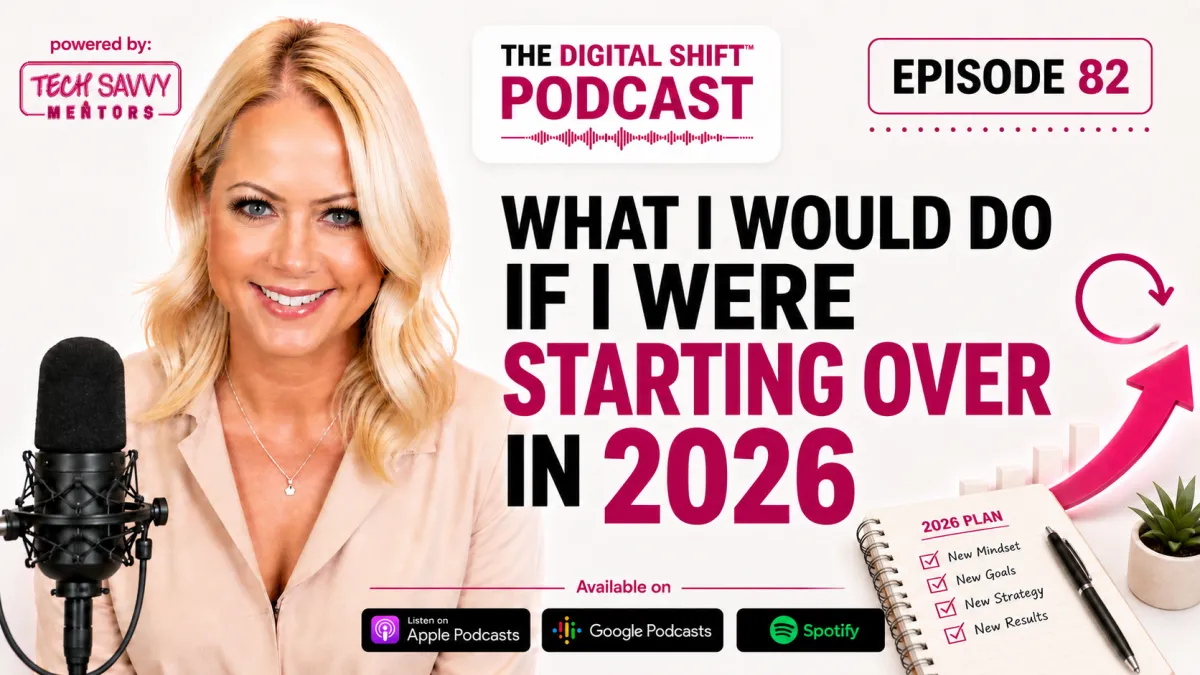
Podcast Episode 82 — What I Would Do If I Were Starting Over in 2026
I spent three years building things in the wrong order, and I worked hard the entire time.
I built the brand before the offer was actually clear. I mapped out funnels before I had a proven conversion path. I hired from desperation instead of data. I made pricing decisions based on what felt right instead of what the numbers said, and I tried to figure out the tech alone because that's what most entrepreneurs do. None of it was laziness. I was putting in the hours. But speed without sequence is the most expensive kind of motion there is, and I didn't understand that until I was already deep in the cost of it.
That realization is the foundation of this episode.
The question I stopped avoiding
What would I actually do differently if I were starting over in 2026?
Most people won't answer that question with any specificity because it means admitting the gap between how you thought things would work and how they actually did. I am willing to name that gap out loud because the version of me that started over with this knowledge would have hit every goal in half the time, and that version can be you.
This episode of The Digital Shift™ is not motivational. It is tactical. It is a real, sequenced blueprint from someone who made every mistake in the book and built the business that works on the other side of them.
The 4 mistakes I would skip entirely
1. Building the wrong things first
Branding before the offer is clear, funnels before there's a proven conversion path. Both feel productive. Neither actually is. The brand can be refined once you know what you're selling and to whom. The funnel has nothing to carry until the offer converts in conversation first.
2. Trying to figure out the tech alone
This one cost me years, not just months. The implementation gap is real. Most entrepreneurs don't need more information, another tutorial, or a different platform. They need someone beside them who has already built what they are trying to build. The mentor shortens the learning curve from years to months, and that math is not small.
3. Hiring from desperation instead of data
Desperation hires feel like solutions and operate like problems. The right hire at the wrong time is still the wrong hire. There is a specific data signal that tells you when to bring someone in, and it has nothing to do with how overwhelmed you feel.
4. Making pricing and marketing decisions based on feelings
Feelings lie. Numbers don't. Pricing based on what feels comfortable almost always means underpricing for the transformation you actually deliver. Marketing decisions made without data get adjusted constantly and never compound. Both are fixable when you build the right foundation first.
The first 30 days — week by week
Week 1: Offer clarity before anything else gets built
Not the website. Not the social media plan. Not the branding. The offer. You need to know exactly what you are selling, who it is for, and what transformation it delivers before a single other thing gets built. Everything else is scaffolding for this.
Week 2: The ability to take money
Before a landing page. Before a content strategy. Before a funnel. You need a way to get paid. A booking link, a payment link, and a conversation. That's it. Revenue validates the offer faster than anything else you could build.
Week 3: The CRM before the funnel
The brain of the business has to exist before the traffic arrives. The CRM is where every lead, every conversation, and every follow-up lives. Build it before you send anyone anywhere.
Week 4: One path, nothing more
One landing page. One offer. One call to action. One follow-up sequence. That's the whole assignment. Nothing else gets built until that single path is converting.
The first system to build
Not a content system. Not an ads system. A follow-up system.
Here is why: 80% of sales happen after the 5th contact. Most entrepreneurs give up after the first. That is not a hustle problem. It is a systems problem, and it is completely fixable.
The follow-up system I would build first responds to every new lead within minutes, nurtures warm leads over 3 to 5 days, re-engages the ones who went cold, and follows up automatically after every call, whether that call led to a yes or a not yet. This system runs without you. That is the point.
The first hire
Not a social media manager. Not a VA for random tasks.
The first hire is someone who owns the operations and the backend, and that frees you to do the work only you can do — the strategy, the relationships, the selling, the mentorship. The VA for random tasks keeps you busy inside the business. The right operations hire moves you outside it.
The exact data signal that tells you the timing is right: your time is worth more than the hire costs, and revenue is consistent enough that the hire doesn't introduce financial pressure that slows you down. Both conditions have to be true.
The path to the first $10K
Four steps. In this order.
Start with conversations before content. Sell in DMs and on calls before you optimize a single post. Content scales revenue that already exists. Conversations create it.
Price for the transformation, not the hours. The hours are inputs. The transformation is the outcome. Your price should reflect what changes for the client, not how long it takes you to deliver it.
Follow up with a system, not with willpower. Willpower runs out. Systems don't. Build the follow-up before you need it.
Build with AI from Day 1. Not retrofitted later. Woven into the infrastructure from the start. The entrepreneurs who are moving fastest right now are the ones who treated AI as a core operating layer, not an add-on.
What I know now that I wish I knew then
Speed without sequence is the most expensive kind of motion. The right mentor shortens the learning curve by years, not weeks. And AI was always going to be part of this — the only question was when.
The right order exists. This episode gives it to you.
Where to start
If any part of this felt like looking in a mirror, the next step is a conversation, not another course.
Book a free discovery call with Misha and walk away with a GHL audit. We will map out exactly where your gaps are and what to build first — no guesswork, no expensive detours, no more building things in the wrong order.
Book your free GHL audit: https://www.self-made.biz/mishacall
Or head to www.self-made.biz to learn how Self-Made Hub gives you the systems, the strategy, the AI integration, and the mentorship that shortens the learning curve from years to months.
Jessica Green is the Founder and CEO of Self-Made Biz and the host of The Digital Shift™, a podcast for entrepreneurs who are done guessing and ready to build. Listen on Spotify, Apple Podcasts, and Amazon Music.